

When builders compare engineered cedar siding vs solid cedar siding, the real decision is not whether one is genuine wood and the other is not. Both can deliver the warmth and character of cedar. The more useful question is how each construction responds to moisture, how predictable it is for a crew to install, and how much labor and maintenance risk the project can absorb. Engineered cedar is made from real Western Red Cedar components assembled for greater stability, while solid cedar relies on one continuous piece of wood. This guide compares the two options for builders, installers, distributors, and design teams planning a premium exterior. For broader product context, review Craft Global's Engineered Cedar Siding, Lumber, and Specialty Cedar Products Buyer Resource Center.
Request a wholesale quote for engineered cedar siding from Craft Global.
Engineered Cedar Siding vs Solid Cedar Siding: Side-by-Side Comparison
Engineered cedar siding is usually the stronger fit when a project prioritizes dimensional stability, predictable installation, and consistent finishing. Solid cedar siding remains a legitimate choice when the design calls for uninterrupted natural boards and the team has planned carefully for acclimation, movement, waste, and maintenance. The right selection depends on the profile, exposure, crew, and project tolerance for rework.
| Decision factor | Engineered cedar siding | Solid cedar siding |
|---|---|---|
| Construction | Real cedar components are joined and assembled into a siding profile. | A single piece of cedar forms the board. |
| Dimensional behavior | Designed to resist cupping and twisting more consistently than a solid piece. | Moves with changing moisture and grain characteristics. |
| Visual character | Real cedar grain and color, with a more uniform manufactured profile. | Uninterrupted grain and the natural variation of each board. |
| Installation planning | Still requires acclimation and correct detailing, but can make layout and finishing more predictable. | Requires careful acclimation, fastening, spacing, and board selection. |
| Best project fit | Premium exteriors where consistency, clean lines, and labor control matter. | Projects where board-by-board natural character is central to the design. |
The table is a planning framework, not a substitute for the manufacturer's installation instructions or the project engineer's details. Engineered construction does not make wood maintenance-free, and solid cedar is not automatically a poor material. Exposure, moisture management, finish selection, fastening, and workmanship influence the result for both products.
Why Does Solid Cedar Warp, Cup, and Twist Over Time?
Solid cedar can warp, cup, or twist when different parts of a board gain or lose moisture at different rates. Grain direction, board width, drying history, exposure, and fastening all affect the amount of movement. These changes are normal wood behavior, but they become a performance problem when movement exceeds the tolerances of the cladding system or creates extra finishing and callback work.
Wood is hygroscopic, which means it exchanges moisture with the surrounding air. The U.S. Forest Products Laboratory explains that moisture affects the dimensional movement of wood products and identifies exterior siding and soffits as applications where that movement can be especially important. Read the USDA Forest Products Laboratory guidance on moisture-related properties of wood when developing a project moisture plan.
What the movement terms mean
- Cupping: The board curves across its width, often creating a concave or convex face.
- Warping: A broad term for unwanted change in a board's original plane.
- Twisting: The corners of a board rotate in different directions along its length.
- Checking and splitting: Surface or end cracks that can develop as wood dries, moves, or is restrained.
Movement does not mean a solid cedar board will fail. Properly selected, acclimated, detailed, fastened, and finished solid cedar can perform well. The risk is that every individual board brings its own grain pattern and moisture history to the wall. Wider boards and boards installed before they reach an appropriate in-service moisture condition can demand more attention from the crew. Fastening through overlapping pieces or restricting the board's expected movement can also create avoidable stress.
That variability matters on high-visibility elevations. A small amount of movement across one board may be manageable. Repeated movement across long runs, window openings, corners, and transitions can make lines harder to keep consistent and can increase touch-up or replacement work.
How Does Engineered Cedar Deliver Dimensional Stability?
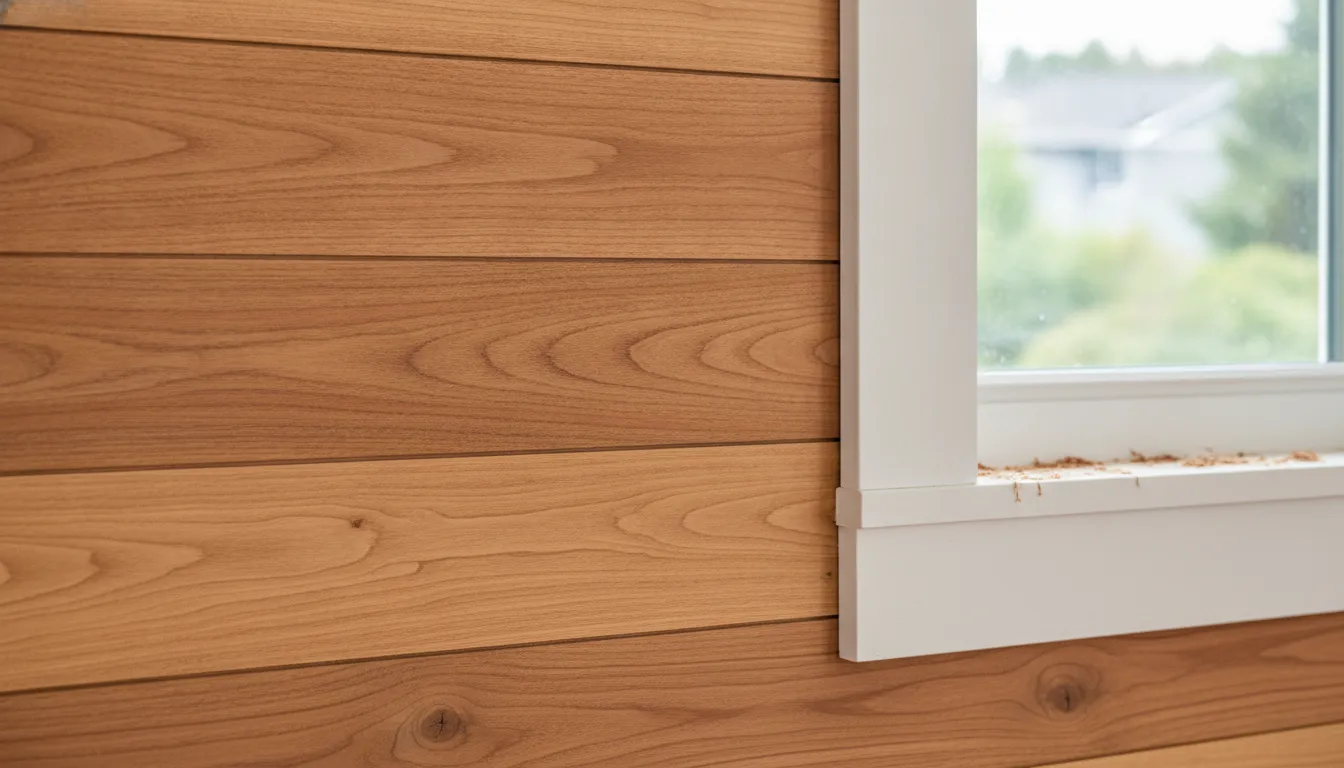
Engineered cedar delivers dimensional stability by joining real cedar components into a manufactured profile instead of relying on one uninterrupted board. The joined construction helps limit the effect of any one piece's grain and movement pattern. Craft Global's clear cedar tongue-and-groove engineered plank uses a jointed and edge-glued backing made of coastal cedar, and the product is positioned for greater cup and twist resistance than a solid piece.
Engineered does not mean synthetic or cedar-look. Craft Global's engineered Western Red Cedar products retain the natural appearance and working characteristics of real wood. The Clear Cedar T&G Engineered Planks are offered in a Micro V profile with nickel gap, fine line, or flush options, and the product page includes a 1x6 CAD drawing and a 10-year warranty. Builders should still review the current product documentation, profile, finish system, and installation guide for each project.
What engineered construction can and cannot solve
Engineered construction can improve consistency, but it cannot correct a wet wall assembly, poor flashing, inadequate drainage, or an unsuitable finish. Cedar siding remains part of a larger enclosure system. The wall needs a sound water-resistive barrier, well-detailed openings, appropriate rainscreen or drainage provisions where required, and fasteners suited to the product and exposure.
The Western Red Cedar Lumber Association installation guidance recommends acclimatizing siding before installation and notes that siding should be fastened so natural movement is not unnecessarily restricted. It also emphasizes proper prefinishing and moisture-aware wall construction. Use the Western Red Cedar siding installation guide as a field reference, then follow the product-specific instructions supplied for the selected profile.
Installation Speed and Labor Cost Differences
Engineered cedar siding can reduce installation friction when a project depends on straight lines, repeatable profiles, and a clean finish across many elevations. Solid cedar may require more board-by-board sorting, trimming, and adjustment because the crew is working with natural variation in each piece. Neither material removes the need for skilled installation, but engineered construction can make labor more predictable.
Where the labor difference can appear
- Receiving and staging: Inspect both materials before installation, but expect more individual variation when sorting solid boards for visible elevations.
- Acclimation: Allow the siding to reach an appropriate moisture condition before installation. This step applies to both products.
- Layout: A consistent engineered profile can simplify course alignment, reveals, and transitions at openings.
- Cutting and fitting: A stable board is easier to handle when the crew is making repeated cuts around corners, windows, and trim.
- Fastening: Follow the product guide. Do not use a fastening pattern that restrains expected movement or creates splitting.
- Finishing: Prefinish and seal end cuts as required by the finish system. Consistent faces can make coating application and inspection easier.
- Quality control: Review alignment, joints, exposed ends, flashing, and finish coverage before the crew leaves each elevation.
The practical labor question is not simply how fast a board can be installed. It is how much time the project can spend on handling, adjustment, rework, finish repair, and callbacks. A builder comparing bids should ask installers to explain those activities rather than comparing material prices alone.
What Is the Long-Term Cost of Ownership?
The long-term cost of cedar siding includes material, labor, waste, finishing, maintenance, and the cost of correcting movement-related issues. Engineered cedar can offer value when its stability reduces handling, rework, or finish problems. Solid cedar can offer value when its natural board character is essential and the project team has the experience and schedule to manage movement. A useful comparison looks beyond the initial quote.
| Cost driver | Questions for the builder |
|---|---|
| Material yield | How much sorting, trimming, and expected waste is included in the takeoff? |
| Labor | Does the estimate account for acclimation, layout, fitting, finishing, and inspection? |
| Finish system | What coating, prefinish, end-sealing, and recoat schedule does the product require? |
| Exposure | How will sun, rain, humidity, drainage, and local climate affect the assembly? |
| Service risk | What is the likely cost of a callback, replacement board, or finish repair on a visible elevation? |
| Documentation | Are warranty terms, installation instructions, CAD details, and finish requirements available before ordering? |
When solid cedar may be the better choice
Solid cedar can be a good fit when uninterrupted grain is a defining design requirement, the profile is well suited to the exposure, and the installation team is comfortable managing natural variation. It can also make sense when the project has a detailed acclimation and finishing plan and the design intentionally celebrates board-to-board character.
When engineered cedar may be the better choice
Engineered cedar is often the better fit when the project needs repeatable dimensions, clean tongue-and-groove lines, greater resistance to cupping and twisting, or more predictable installation across a large or highly visible exterior. It is also useful when a builder wants real Western Red Cedar while reducing some of the variability associated with a solid piece.
Request a project-specific cedar siding quote and product guidance from Craft Global.
Frequently Asked Questions
Is engineered cedar siding real wood?
Yes. Engineered cedar siding is made from real cedar components that are joined into a manufactured siding profile. It is not a plastic or printed wood substitute. The construction is intended to improve stability and consistency while preserving the appearance of natural cedar.
Does engineered cedar siding eliminate warping?
No wood siding product eliminates all movement or installation risk. Engineered construction is designed to resist cupping and twisting more consistently than a solid piece, but the wall assembly, moisture control, acclimation, fastening, flashing, and finish still determine how the siding performs.
Which is easier to install, engineered or solid cedar siding?
Engineered cedar can be easier to handle and install predictably because its manufactured profile is more consistent. Solid cedar can also install successfully, but the crew must account for natural variation, board movement, acclimation, sorting, and the correct fastening details.
Is engineered cedar siding more expensive than solid cedar?
There is no universal answer because pricing depends on species, grade, profile, quantity, finish, freight, and regional labor. Compare the complete installed cost, including waste, handling, finishing, and potential rework, rather than comparing board prices alone.
Can engineered cedar siding be used for soffits and interior applications?
Some engineered cedar profiles can be used for soffits, fascia, trim, ceilings, and interior applications, but suitability depends on the specific product and installation environment. Confirm the intended use, profile, finish, and warranty requirements before specifying it.
What should builders request before ordering cedar siding?
Request the current product specifications, installation instructions, CAD details, finish requirements, warranty terms, available profiles, quantity guidance, and delivery information. Craft Global can help trade buyers evaluate engineered cedar siding for a specific project and request a wholesale quote.
Conclusion
Engineered cedar siding and solid cedar siding both bring real wood character to a building, but they manage variability differently. Solid cedar gives the team an uninterrupted board and natural variation to work with. Engineered cedar uses joined real-wood components to pursue greater dimensional stability and more predictable handling. For builders, the best choice comes from matching the product's construction to the exposure, visual standard, crew, schedule, and long-term maintenance plan.
For more category context, return to Craft Global's Engineered Cedar Siding, Lumber, and Specialty Cedar Products Buyer Resource Center, then review the available engineered cedar siding collection and contact the team for project-specific guidance.